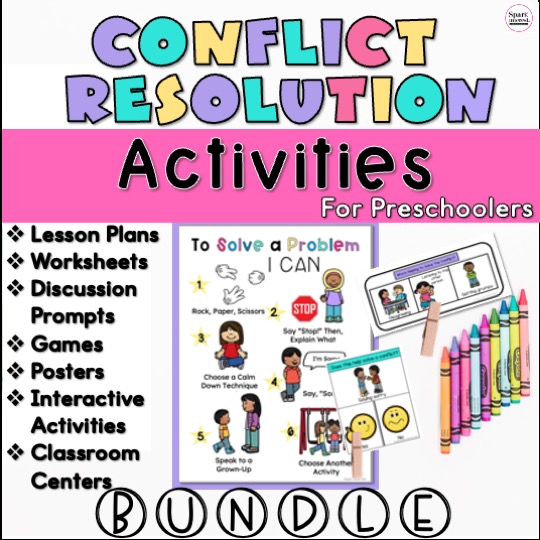
Conflict resolution can be tricky for all of us sometimes. So when you picture a room full of four-year-olds trying to work through sharing issues, hurt feelings, and “he took my spot” drama… well, it makes sense that this skill needs a lot of teaching.
Our little learners are still figuring out how to manage their feelings, communicate what they need, and understand the difference between a small problem and a really big one. And while they’re learning all of that, they’re also trying to navigate daily disagreements with their classmates.
That’s where we come in.
The good news is that teaching conflict resolution to preschoolers does not have to feel overwhelming. In fact, it can be woven into everyday classroom moments in simple, playful, and really effective ways.
If you’re looking for a place to start, this post will walk you through some of my favourite ways to teach conflict resolution skills in Preschool, Pre-K, and Kindergarten so you can support calmer, more confident problem-solving in your classroom.
And if you’d like a simple free resource to support this work, you can also grab my FREE Conflict Resolution Booklet here.

What is Conflict Resolution?
Conflict resolution is the process of helping two or more children work through a disagreement in a peaceful and respectful way.
In early childhood, that might look like:
- helping children name the problem
- supporting them to talk about what happened
- guiding them to listen to each other
- and helping them think of a solution
A lot of classroom conflicts happen because children do not yet have the language, regulation, or perspective to handle the moment on their own.
Sometimes they are feeling frustrated and do not know how to say it.
Sometimes they are overwhelmed.
Sometimes they simply do not know what to do next.
That is why teaching conflict resolution matters so much in the early years.
How to Teach Conflict Resolution
Trust me when I say, teaching conflict resolution to preschoolers is very doable.
This is one of those social-emotional skills that fits so naturally into classroom life because the opportunities to teach it are everywhere. And while that can feel exhausting in the moment, it also means children get lots of real chances to practise.
If you’re wondering how to teach conflict resolution in a way that actually works for young children, here are some simple and effective places to start.

Step 1: Teach Size of the Problem
To a preschooler, a lot of problems can feel like big problems.
Someone took their spot on the carpet? Huge problem.
A friend used the paintbrush they just put down? Disaster.
A buddy does not want to play the same game? End of the world.
Sound familiar?
Before children can work through conflict calmly, it really helps for them to begin learning the difference between a small, medium, and big problem.
Start by talking about:
- what a big problem is
- what a medium problem is
- what a small problem is
- which problems need a grown-up’s help
- which problems children may be able to solve on their own
This gives children a really important foundation. It helps them begin to understand that not every conflict needs the same sized reaction.
If you want to go deeper with this, you might also like:
- 6 Easy Ways to Teach Size of the Problem in Your Preschool Classroom
- 50 Size of the Problem Examples for Preschool, Pre-K, and Kindergarten
Step 2: Teach Conflict Resolution Techniques
Once children begin to understand the size of a problem, they need some tools for what to do next.
This part is so important.
Because a lot of children know they are upset, but they do not yet know how to move forward.
Keep it simple with easy, classroom-friendly conflict resolution strategies like:
- talk to a grown-up for bigger problems
- walk away
- choose another activity
- use rock-paper-scissors for small disagreements
- say “I’m sorry” when it fits the situation
- use a calm-down strategy
- say “stop” and explain why
The more children see, hear, and practice these techniques, the more familiar they become.
If you’d like ready-to-use activities for teaching and practising these skills, my Conflict Resolution Activities for Preschoolers are a helpful next step.
Step 3: Role Play Conflict Resolution Scenarios
Role play is one of the best ways to teach young children social-emotional skills because they get to see the problem, hear the language, and practise it in a safe and supportive way.
You might start by modelling a conflict yourself, then invite children to join in.
Use real classroom situations they can actually relate to:
- someone grabbing a toy
- a friend saying something unkind
- two children wanting the same thing
- someone not listening when another child says stop
Children love seeing familiar situations acted out, and that’s often when the learning really starts to stick.
If you’d like to give your students more practice working through everyday social problems, this list of 40 conflict resolution scenarios for preschoolers might come in handy.
And if you want ready-to-use scenarios for role play, discussion, and social skills practice, my Conflict Resolution Scenarios for Preschoolers are a great support too.

Step 4: Play Games to Teach Conflict Resolution
🔵Conflict Resolution Bingo
Fill a bingo board with different resolution techniques and mark them off as children use them during the week.
👯Matching Games
Match common classroom conflicts with possible solutions so children can practise problem-solving in a hands-on way.
☮️Peace Corner Activities
Set up a peace corner with visuals, props, cue cards, and books to support children in working through conflict with guidance.
🎭Storytelling or Puppet Play
Invite children to create little stories or puppet shows about solving social problems.
🥹Emotion Charades
Helping children recognise and name emotions is such an important part of conflict resolution too.
These kinds of activities help children build conflict resolution skills in a playful, low-pressure way, which is often exactly what they need.
If you’d like more hands-on ideas, you might also enjoy 5 Effective Preschool Conflict Resolution Activities That Absolutely Work.
If your students learn best through play, my Conflict Resolution Games for Preschoolers are another fun way to keep practising these skills in a low-pressure way.
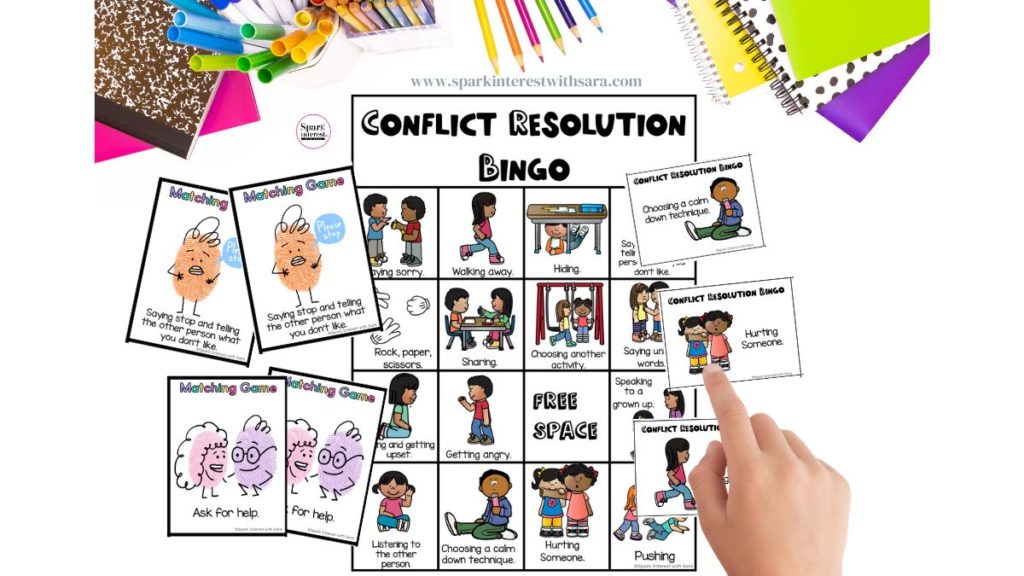
For simple independent practice, Conflict Resolution Clip Cards can also work well in centres or small group rotations.
Step 5: Involve Families
Like so many social-emotional skills, conflict resolution grows more quickly when children have chances to practise it beyond the classroom too.
A simple way to support that is by involving families.
You might:
- send home a simple booklet with conflict resolution strategies
- share tips in newsletters
- talk about it at parent meetings
- encourage families to role play common conflict scenarios at home
The more children hear the same language and practise the same ideas, the more natural those skills become.
If you’d like a simple resource to share with families, you can grab my FREE Conflict Resolution Booklet here.

Why teaching conflict resolution matters so much
Teaching conflict resolution is not just about solving today’s squabble over the dollhouse or who had the shovel first.
It is about helping children build lifelong social-emotional skills.
When children learn how to work through conflict, they are learning how to:
- communicate clearly
- listen to others
- name their feelings
- problem-solve
- repair relationships
- ask for help when they need it
And yes, it can also lead to a calmer classroom over time, which is a pretty lovely bonus.
Because let’s be honest, fewer little arguments needing adult rescue every five minutes is a win for everyone.

Final thoughts on teaching conflict resolution skills
Conflict resolution is one of those skills that takes time, repetition, and lots of support.
Some children will pick it up quickly. Others will need many, many chances to practise. That is normal.
The goal is not perfect conflict resolution every time. The goal is helping our students slowly build the awareness, language, and confidence to work through social problems in more helpful ways.
And that work matters so much.
If you’d like more support with this topic, you might also like:
- 40 Conflict Resolution Scenarios for Preschoolers
- 5 Effective Preschool Conflict Resolution Activities That Absolutely Work
- How to Help Preschoolers with Self Regulation
And finally, if you want all of these ideas and support in one place, my Conflict Resolution Bundle is a helpful next step for teaching and reinforcing this skill in the classroom.