
If you teach young children, you already know that conflict is part of the deal.
It shows up at the paint easel, during block play, on the mat, in the sandpit, and basically anywhere two or more little humans are trying to exist in the same space with their own big feelings, strong ideas, and still-developing social skills.
One child grabs the red marker.
Someone says, “You can’t play.”
Two children both insist they had it first.
A tower gets knocked over and suddenly you’ve gone from happy play to tears, yelling, and a full emotional scene in about ten seconds flat.
Sound familiar?
That’s why I think conflict resolution scenarios for preschoolers give you simple, classroom-friendly ways to teach problem-solving, communication, and social skills.
Because young learners are not born knowing how to work through disagreements calmly. They are still learning how to share, how to wait, how to listen, how to speak up, how to handle disappointment, and how to solve problems without everything falling apart.
That is big work.
And honestly, I think sometimes we expect a lot from them socially without always realising just how many skills are wrapped up in one little classroom conflict.
That is why I love using conflict resolution scenarios.
They give us a chance to slow things down and practice when children are calm. They help us take common classroom conflicts and turn them into teachable moments. And they give children language and problem-solving practice before the next real-life disagreement pops up five minutes later near the glue sticks.
If you’re working on this skill with your students, you can also grab my free Conflict Resolution Booklet for extra support with classroom discussions and problem-solving practice.

So if you’ve been looking for conflict resolution scenarios for Preschool, Pre-K, and Kindergarten, here are 40 classroom-friendly examples you can use in morning meeting, SEL lessons, small groups, role play, and social skills discussions.
What is conflict resolution in early childhood?
In the early years, conflict resolution is really about helping children learn how to work through problems with support, not shame.
It is not about forcing a quick apology just to move on.
And it is definitely not about expecting young children to already know what to say or do when things go wrong socially.
Conflict resolution is about helping children learn how to:
- notice when there is a problem
- recognise how they are feeling
- understand that another person has feelings too
- use words to express what they need
- think of a solution
- try a way forward
When you write it out like that, it is no wonder children need lots of practice.
That is a whole bundle of social-emotional skills right there.
If you want a broader look at how to teach this in the classroom, you might also like How to Teach Preschoolers Conflict Resolution Skills in Fun and Effective Ways.
And if you want more hands-on ideas, you might also enjoy 5 Effective Preschool Conflict Resolution Activities That Absolutely Work.
How to use conflict resolution scenarios in the classroom
One of the things I love most about using scenarios is that they make social learning feel much more concrete.
Instead of only trying to teach conflict resolution in the middle of a real argument, when everyone is upset and dysregulated, you get to practice the skill when things are calm.
That changes everything.
Because when children are calm, they can actually process much better. They can listen. They can talk through what happened without being completely swept away by the feeling of it.
You can use conflict resolution scenarios in so many easy ways:
- morning meeting
- SEL lessons
- small group work
- puppet play
- partner discussions
- role play
- social skills groups
- whole-class chats after a tricky classroom moment
You might read a scenario aloud and ask:
- What happened here?
- How might each child feel?
- What could they say?
- What could they do next?
- Do they need help from a teacher?
- What would be a kind and fair solution?
These conversations can be so rich.
And the beauty is that children start building the language and problem-solving skills before the next real conflict happens.
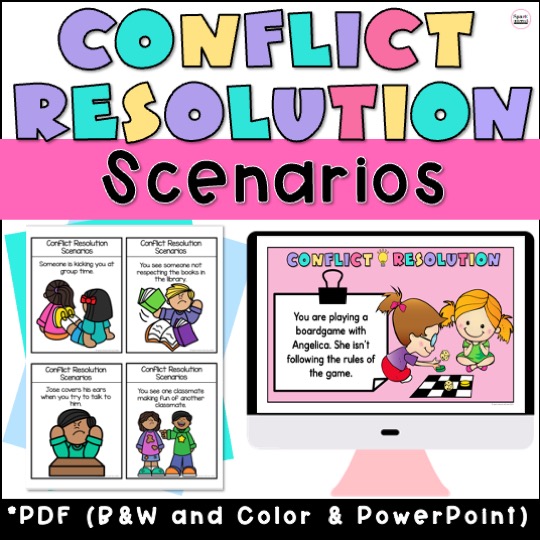
If you want ready-to-use materials for this kind of practice, these Conflict Resolution Scenarios for Preschoolers are a great support for role play, discussion, and social skills lessons.
40 conflict resolution scenarios for Preschoolers and Kindergarten Students
I’ve broken these into simple categories because I always find that easier as a teacher too.
When the scenarios are grouped by theme, it is much easier to choose what fits the needs of your class. Maybe your group is really working on sharing. Maybe friendship issues are popping up a lot lately. Maybe personal space is the big one right now.
This way, you can go straight to the section that feels most relevant.
Sharing and turn-taking conflict resolution scenarios
Let’s be honest, these are some of the most common conflicts in any early childhood classroom.
- Two children want the same toy at the same time.
- A child grabs the only red marker from someone else.
- One child says, “I had it first.”
- A child does not want to wait for a turn on the swing.
- Two children both want to be first in line.
- One child keeps holding onto all the blocks and will not share.
- A child takes a shovel from another child in the sandpit.
- Two children want the same dress-up costume.
These are so useful because nearly every child can relate to them. They feel real straight away.
Friendship and play scenarios
Friendship conflicts can feel huge to young children, even when they seem minor to us.
- A child says, “You can’t play with us.”
- Two children want different roles in pretend play.
- One child keeps changing the rules of the game.
- A child walks away and the other child feels upset.
- Two children both want to choose the same game.
- A child says, “You’re not my friend anymore.”
- One child wants to play something different and the other gets angry.
- A child feels left out when friends are already playing together.
These are the kinds of scenarios that open the door to really important conversations about belonging, flexibility, and kind communication.
Personal space and body boundary scenarios
This is such an important area in the early years too.
- A child stands too close to another child.
- Someone keeps touching another child’s work.
- A child bumps into someone and they think it was on purpose.
- One child keeps following another child who wants space.
- A child hugs someone who does not want a hug.
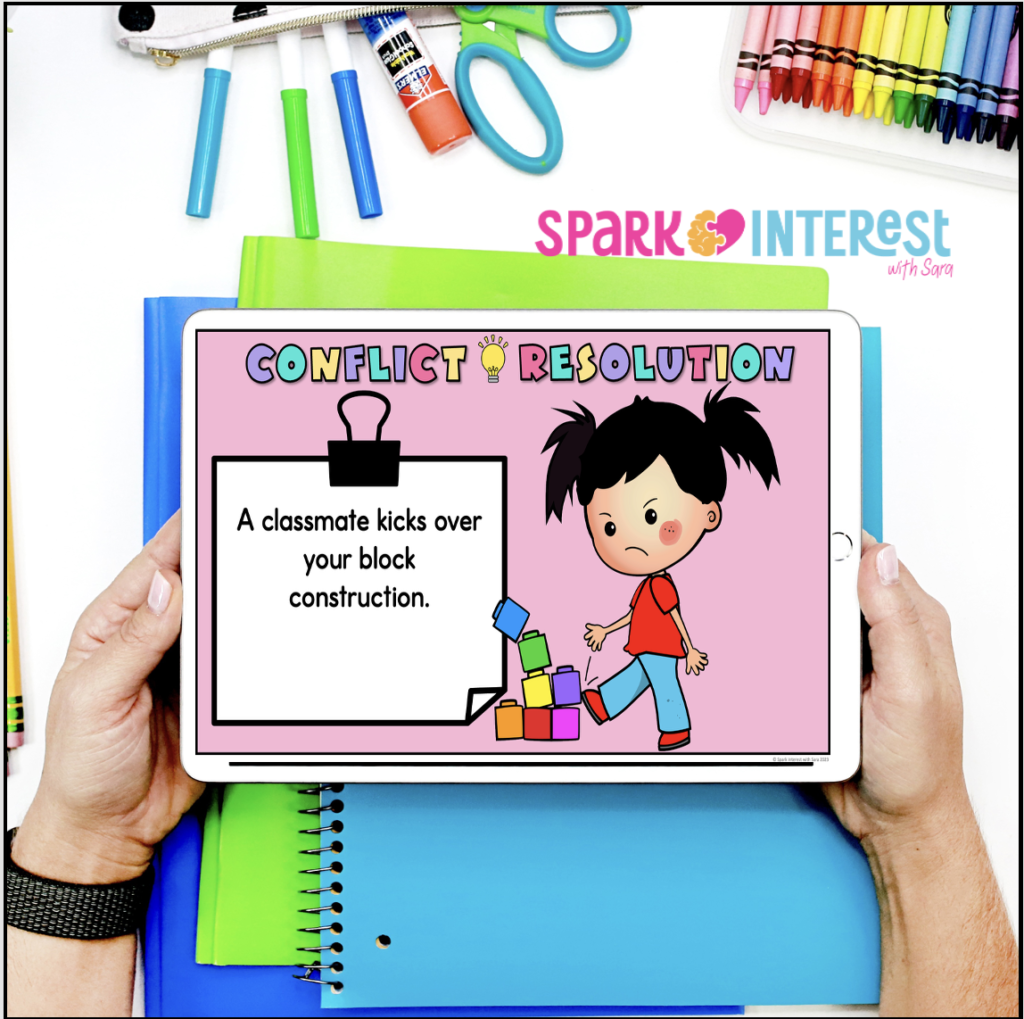
- A child knocks over another child’s block tower while reaching across the table.
- One child keeps leaning on another child during group time.
- A child grabs another child’s hand or arm during play.
There is so much good teaching in these moments around body boundaries, consent, and respectful behaviour.
Hurt feelings and communication scenarios
Sometimes the biggest part of the conflict is not what happened. It is how it was said.
- A child says something unkind about another child’s drawing.
- One child laughs when another child makes a mistake.
- A child yells instead of using words.
- One child says “stop” and the other child keeps going.
- A child interrupts and will not let another child talk.
- Someone blames another child for a mess they both made.
- A child uses a rude tone and hurts someone’s feelings.
- Two children are arguing and neither is listening.
This is where simple scripts, sentence stems, and lots of modelling can make such a difference.
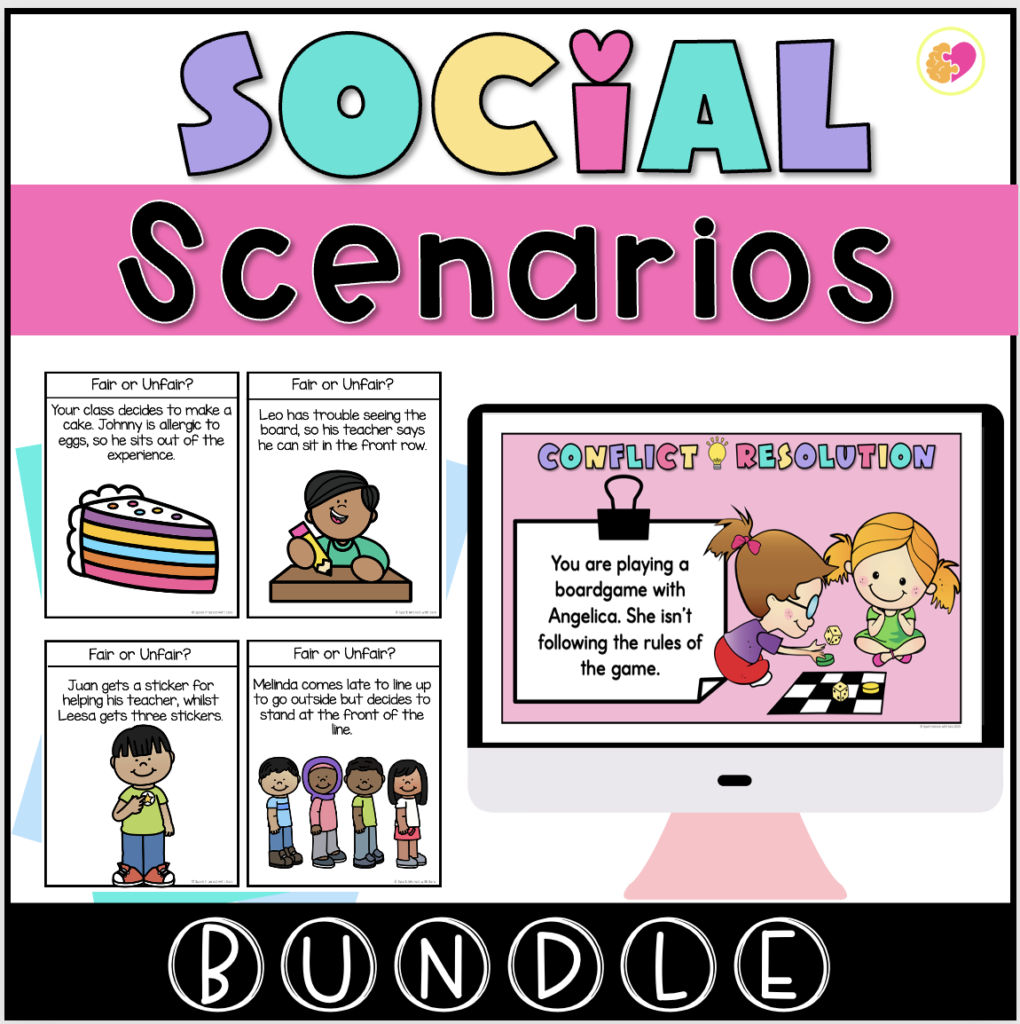
If your students need support with everyday social situations beyond conflict resolution, my Social Scenarios Bundle is another really helpful way to build communication and problem-solving skills across different topics.
Classroom problem-solving scenarios
And then there are those classroom conflicts that are part social problem, part practical problem, and part “well, here we are.”
- A child knocks over another child’s work and they start arguing.
- Two children both think they are supposed to sit in the same spot.
- Someone takes materials from the table without asking.
- A child is upset because their friend will not let them join the game.
- Two children are arguing over who is telling the truth.
- One child gets angry when their idea is not chosen.
- A child refuses to listen when another child asks for space.
- Two children both think the classroom job belongs to them.
These are the everyday moments where all the social-emotional learning work really starts to matter.
A gentle reminder when teaching conflict resolution
This part feels important to say…Conflict resolution is not about getting children to say the “right” thing as quickly as possible. It is not about performing a tidy little apology because an adult is watching. And it is not about expecting every conflict to wrap up neatly in the moment.
Sometimes children are too upset to solve the problem straight away.
Sometimes they need help just to pause and breathe.
Sometimes one child needs space before they can even talk.
And honestly, that is okay.
The goal is not perfection. It is progress.
We are helping children build these skills over time. Bit by bit. Conflict by conflict. Repair by repair.
That is meaningful work.
Tips for teaching conflict resolution through scenarios
Once you have a bank of scenarios to work with, there are so many easy ways to bring them to life.
🎭 Use puppets or role play
Puppets, dolls, and simple role play can make these scenarios feel safe and approachable, especially for younger children.
Sometimes children understand a social situation much more easily when they can watch it play out first.
🎙️ Keep the language simple
Our young learners need words they can actually use in real life.
Try simple phrases like:
- “Can I have a turn when you’re done?”
- “I don’t like that.”
- “Stop, please.”
- “Can we work it out?”
- “Can I play too?”
Simple is often best.
🔁 Revisit common conflicts often
If the same kind of conflict keeps popping up in your classroom, that is not a failure.
It is actually helpful information.
It shows you which skill needs more teaching, more modelling, and more practice.
🔗 Connect it with other SEL skills
Conflict resolution connects so naturally with Size of the Problem, Asking for Help, feelings and emotions, friendship skills, and problem-solving.
Some children need help deciding whether a conflict is a small problem or something bigger. Others need support knowing when to try solving it themselves and when to ask for help.
If your students benefit from practising lots of everyday social situations, my Social Scenarios Bundle can be a really helpful support here too.
A helpful resource for teaching conflict resolution
If you want ready-to-use support for teaching and reinforcing these skills, my Conflict Resolution Bundle is a helpful next step for Preschool, Pre-K, and Kindergarten classrooms.
It works well for:
- SEL lessons
- morning meeting
- role play
- social skills groups
- small group support
- whole-class discussions
And truly, having something ready to go makes this work so much easier when these same social challenges keep popping up again and again.

Related SEL topics to pair with conflict resolution
One of the things I love about teaching conflict resolution is that it never really sits on its own.
It connects beautifully with:
When children can recognise the size of a problem, understand how they feel, and use words to ask for support or solve a disagreement, everything starts to work together a little more smoothly.
Final thoughts on conflict resolution scenarios for preschoolers
Conflict is a normal part of early childhood.
It does not mean children are being “bad,” and it does not mean you are doing anything wrong as the teacher.
It means children are still learning.
They are learning how to share, how to wait, how to speak up, how to listen, how to handle disappointment, and how to be in relationship with other little humans who also have needs and feelings and opinions.
That is big work.
Using conflict resolution scenarios for preschoolers is such a practical, helpful way to support that learning.
It gives children the chance to practise before the next real-life moment arrives. It builds language, empathy, and problem-solving skills in a way that feels manageable and concrete.
And over time, all of that practice really does add up.

