

“Hey! That’s not fair!”
If you’ve been in a classroom for more than five minutes, you’ve probably heard those four words and you’ll hear them a lot during the school year. Young children have a strong sense of justice (especially when they think they’ve missed out on something!). But here’s the thing: fair doesn’t always mean equal and that’s a tricky concept for little learners to grasp.
In this post, we’re breaking down how to teach Fair vs Equal to young children in a way that actually makes sense to them and sticks. You’ll find simple tips, classroom-tested ideas, and helpful resources to make this big SEL idea feel doable and developmentally appropriate.
🔗 Related reading: How to Teach Fairness to Preschoolers and Help Them Develop Empathy
🌸 Fair vs Equal: What’s the Difference?
Let’s keep it simple:
- Equal means everyone gets the same.
- Fair means everyone gets what they need.
We love using visuals to make this concrete: Think of three kids trying to see over a fence. If they each get the same-sized stool, only some might see. But if each gets a stool the right size for them, everyone gets a fair chance.
For your classroom, that might mean:
- One child gets extra time to finish their work.
- Another uses a fidget tool while others don’t.
- One student may need more adult support during group activities.
It’s not always the same but it’s fair.

👩🏻🏫 Why Teaching Fair vs Equal Matters in the Early Years
“That’s not fair!” is practically a preschool catchphrase. And while it might sound like whining to some, as educators we know it’s a teachable moment just waiting to happen.
Helping little learners understand Fair vs Equal is more than just clearing up playground drama. It’s a social-emotional superpower. And the best part? Research totally backs us up on this.
It Supports Brain Development (Like, Literally Builds It)
The early years are when kids’ brains are wiring up like crazy, not just for reading and maths, but for emotions, too. A working paper from Harvard’s Center on the Developing Child explains how emotional development is just as critical as academics. That means when we teach kids to talk about fairness, manage big feelings, and problem-solve together—we’re literally helping their brains grow in all the right places.
Children Already Have a Sense of Fairness (We Just Help Shape It)
By age 3, many kids already show signs of caring about fairness, especially when it comes to sharing or taking turns. A study in Frontiers in Psychology found that toddlers actually prefer equal sharing in certain situations. How cool is that?
What does that mean for us? The concept of fairness isn’t something we have to force, it’s already budding inside them. We just help it blossom by creating space to talk, explore, and reflect.
It Builds Empathy and Moral Understanding
Fairness is the foundation of empathy. When we ask questions like “How do you think they felt?” or “What would be fair for everyone?”—we’re helping children stretch beyond “me” and consider “we.” A 2023 study in Early Childhood Education Journal showed that even young preschoolers can use moral reasoning and offer solutions when fairness is discussed in context.
It’s not about lecturing, it’s about listening, storytelling, and real-life examples that bring it home.
By framing fairness as part of everyday choices, you’re helping kids build moral understanding, not just following rules.
Helping students understand fairness also means helping them understand the size and scale of different problems. This sets them up to respond appropriately, regulate their emotions, and develop empathy over time.
🟢 Free Support Tool: My Size of the Problem Freebie is a simple visual you can print and use to talk about small, medium, and big problems, perfect for SEL moments, class meetings, or calming corners.

🌟 Fair vs Equal Activities for the Early Years
Before we can expect our little learners to navigate fairness in the heat of the moment, it helps to teach it explicitly first.
Think of it like planting seeds. If we want our classroom culture to be rooted in kindness, empathy, and fairness, we’ve got to make space for those conversations to bloom.
That’s why I always recommend planning at least one or two intentional lessons around Fair vs Equal early in the year (and revisiting them often!).
✔️ Start with a Dedicated Fairness Lesson
A well-planned fairness lesson gives your students language, visuals, and real-life context to wrap their heads around this big idea. It sets the tone that in your classroom, we talk about fairness, we notice fairness, and we care about what others need.
You might:
- Share a story or puppet show that introduces a fairness dilemma
- Use props like band-aids, chairs, or snacks to demonstrate equal vs fair
- Create anchor charts with fairness language or examples from your class
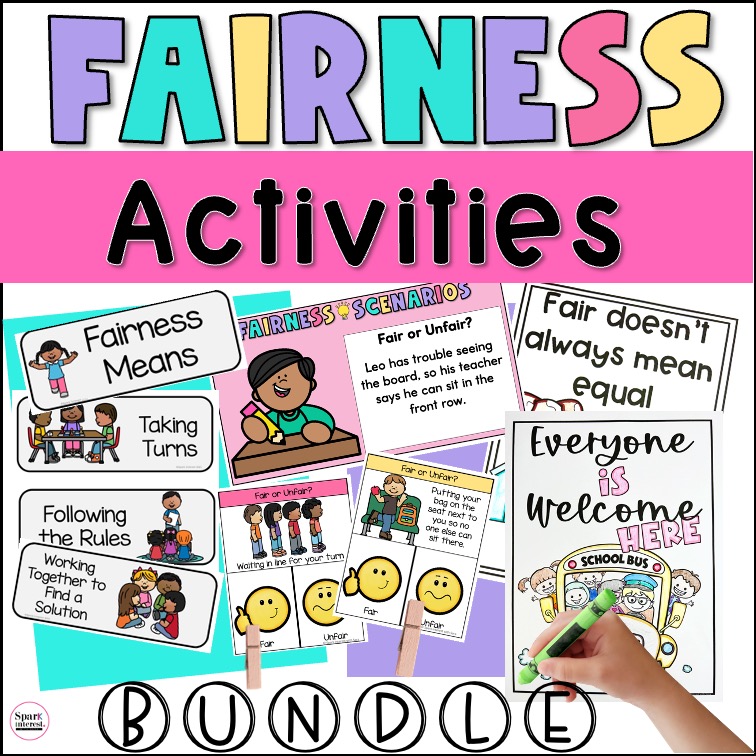
🟢 Need a helping hand? My Fairness Activities Pack includes lesson-ready ideas, games, visuals, and group activities you can use right away.
✔️ Keep the Learning Going with Engaging Follow-Up Activities
Once you’ve introduced the concept, keep the conversation going with activities that help reinforce and explore fairness in different ways:
💬 Real-Life Scenarios for Circle Time
Let kids problem-solve with short, relatable dilemmas:
“Riley forgot his lunch, should we share ours?”
“Aria got a long turn on the swing yesterday… what would be fair today?”
🟢 Check out my ready-made Fairness Scenarios for thought-provoking class discussions.
🖐️ Clip Cards for Centers
Simple but powerful. Students look at a picture and decide: Is this fair or unfair? These spark amazing peer conversations during independent work time.
🟢 Explore the Fairness Clip Cards – perfect for preschool through Year 1.

🎨 Coloring as SEL Reflection
Sometimes kids need space to process big ideas quietly. Fairness-themed coloring pages give them a calm way to think and express themselves.
🟢 Grab the Fairness Coloring Pages for reflection time or early finishers.
✏️ Worksheets for SEL Journals or Portfolios
Reinforce key concepts and encourage personal connections with simple, developmentally appropriate worksheets.
🟢 These Fairness Worksheets are great for small groups, assessment, or end-of-unit wrap-ups.

These Fairness Worksheets were made to complement your Unit on Fairness and to promote discussion and reflection on what fairness looks like in the classroom and playground.
Next Up: How to Create a Fair vs Equal Lesson Plan
Once you’ve explored a few hands-on activities and had those class conversations, you might be wondering: How do I pull it all together into a complete lesson? Don’t worry—I’ve got you covered. In the next section, I’ll walk you through a super simple, heart-centered way to create a Fair vs Equal lesson plan that works for your learners and your schedule.
✏️ How to Create a Fair vs Equal Lesson Plan (That Actually Sticks)
Once you’ve introduced fairness with a dedicated lesson or two, and your students have started dipping their toes into what fair vs equal really means, it’s time to bring it all together into a simple, thoughtful lesson plan.
Don’t worry, this doesn’t need to be fancy or time-consuming. You’re already doing the work in those teachable moments. A good Fair vs Equal lesson just gives you the structure to intentionally guide your class through the concept.
Here’s a simple flow you can follow:
🗂️ Fair vs Equal Lesson Plan Framework
- ✨ Hook
Begin with a question or story that sparks curiosity.
“Ava got two turns on the swing because she missed out yesterday, what do you think about that?” - 🎭 Teach It Visually
Use props like stools of different heights, band-aids on various body parts, or snack comparisons. Show them that equal isn’t always fair, and vice versa. - 🤔 Invite Exploration
Choose a follow-up activity that gets them thinking:- Use a scenario to discuss what fairness looks like in context
- Try a clip card sort to spark conversation
- Or act out a mini role-play and have them decide what’s fair
- 🖍 Reflect Together
Let them draw, write, color, or talk about a time something felt fair or unfair. This builds emotional literacy and personal connection to the concept. - 🌈 Anchor It to Your Classroom Values
Wrap up with a reminder of your classroom expectations and agreements.
“In our classroom, we care about what people need. That’s what fairness means.”
🟢 Want something ready-made? My Fairness Activities Pack and Fairness Scenarios include everything you need to introduce fairness in a fun, accessible way—with zero stress.
💬 Quick Phrases to Use in the Moment
Even after your students understand the concept, real life happens. Someone gets a different job. Someone else gets a special tool. Feelings bubble up and that’s okay!
These quick teacher phrases help reinforce fairness on the fly, without needing to launch into a full lesson every time:
Teacher Sayings to Keep Handy:
- “Fair doesn’t mean everyone gets the same.”
- “In our class, fair means everyone gets what they need to learn and grow.”
- “That might look different, but it’s still fair.”
- “I can help you understand why I made that choice.”
Student Voice Examples:
- “It’s fair because she needed extra help.”
- “He got a turn yesterday, so I get one today.”
- “She was feeling sad, so the teacher stayed with her.”
⚡️Pro Tip: Repeating these phrases consistently will help your students start using them too. That’s when the real magic happens, when fairness becomes part of your classroom culture.
🌱 Keep the Conversation Going All Year
Fairness isn’t a one-and-done topic. It’s a thread that weaves through every part of your day, especially in early years where kids are constantly learning how to navigate the world with others.
Here are some simple ways to keep the Fair vs Equal conversation alive all year:
📆 Revisit Fairness Regularly
- Use morning meeting to reflect on a fairness scenario
- Add fairness questions into your storytime discussions
- Celebrate “fairness moments” you notice throughout the day
🪴 Embed It in Your Classroom Culture
- Create an anchor chart with class ideas of what fairness looks, feels, and sounds like
- Model fairness in your choices and talk through your reasoning out loud
- Let fairness be part of your problem-solving toolkit, not just a one-off lesson
🧠 Check for Understanding Often
- Ask: “What would be fair here?”
- Let students offer solutions and practice seeing things from another’s perspective
⚡️Remember: the more you model and talk about it, the more your students will absorb it, not just in school, but beyond.
💖 Final Thoughts About Teaching Fair vs Equal
If no one’s told you lately…you’re doing amazing work.
Teaching Fair vs Equal might feel like a small part of your week, but it’s actually huge. You’re helping your students understand how to care for others, speak up, listen, share, and show compassion. You’re laying the foundation for empathy, kindness, and inclusion…and that’s something the world really needs more of.
You don’t need to be perfect. You just need to be present. And every time you pause to help your students make sense of fairness, you’re making a difference that ripples way beyond the classroom.
And if this post was helpful, I’d love it if you shared it with your teacher bestie, team, or on Pinterest, it helps more educators bring these important conversations into their classrooms.
You’ve got this 💛

