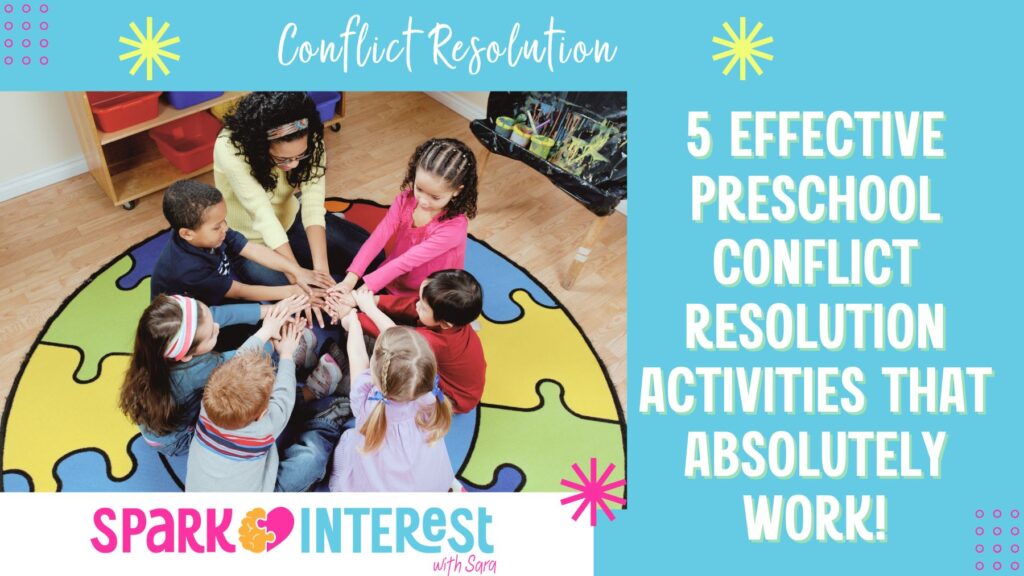
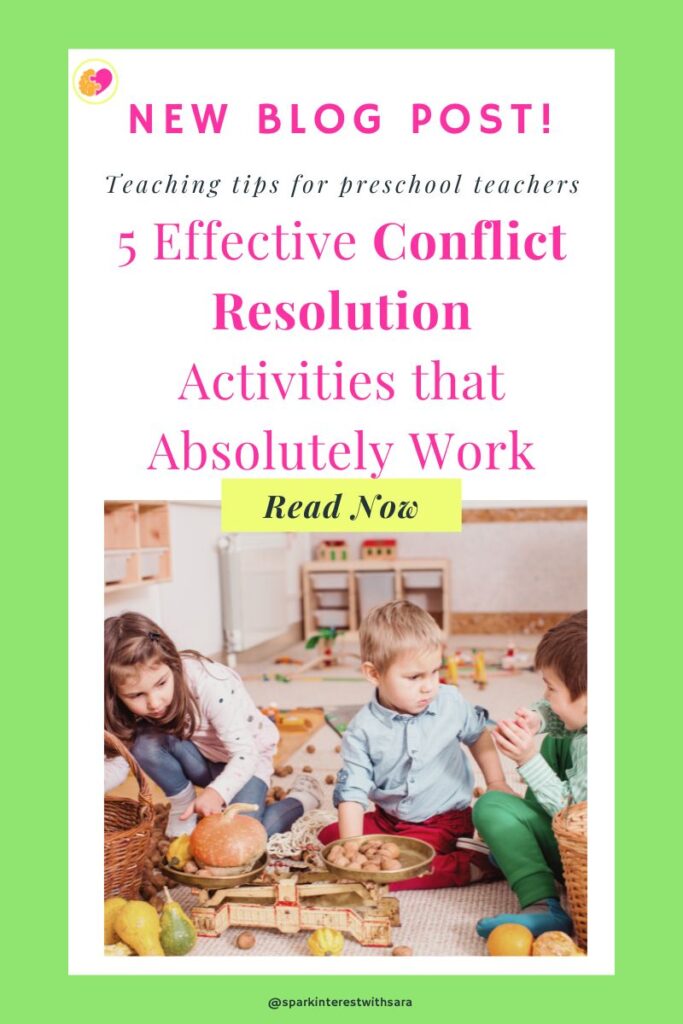
Are you looking for preschool conflict resolution activities that are easy to use and actually effective? Do your preschoolers often struggle to solve conflicts, argue with classmates, or run to you upset?
Preschool is a time of so much growth, and one of the most important life skills our young learners can begin building is conflict resolution. While it can feel a little daunting at first, it really does not have to be complicated. These skills can be taught naturally and reinforced over time through simple, playful classroom activities.
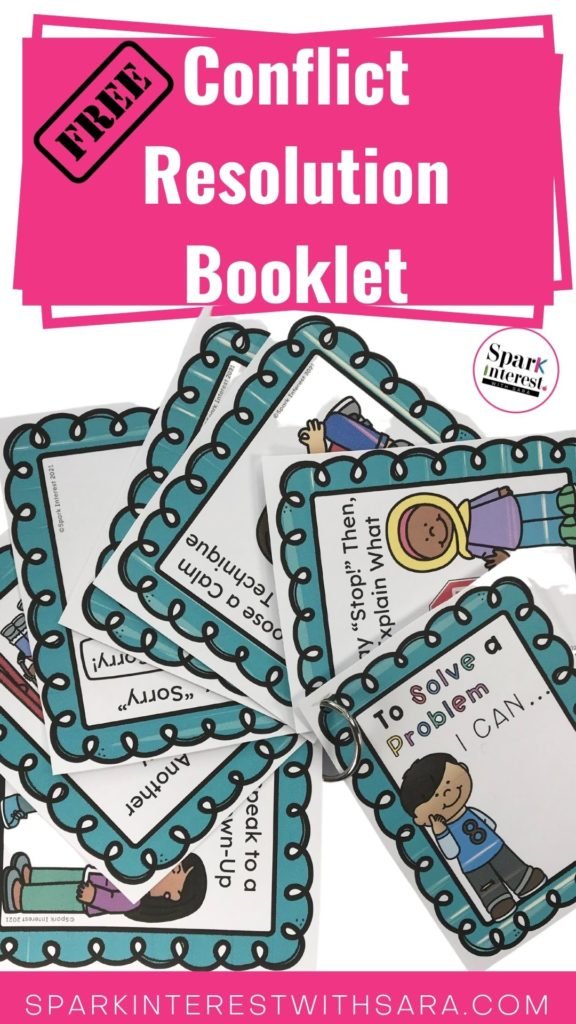
Before we jump into these preschool conflict resolution activities, make sure you grab my FREE Conflict Resolution Booklet. It’s a simple print-and-use freebie that gives young learners strategies for solving common classroom problems. You can download it by clicking on the image below.

Why Teach Conflict Resolution in Preschool?
According to U-Gro, conflict resolution is critical to teach because it allows young children to learn how to listen and cooperate with others. It also teaches them how to communicate their thoughts and feelings, become more aware of their needs, and think creatively to solve problems.
It can seem overwhelming at times because, for the most part, our preschoolers are only just learning to communicate their needs and wants in a productive manner and it is only through practice and repetition that they will begin to manage these difficult situations independently. To make your life a little easier here are some conflict resolution activities for you to implement.
5 Preschool Conflict Resolution Activities:
1. Introduce Techniques to Solve Minor Conflicts
When your young learners constantly come up to you wanting help in solving their conflicts, it provides you with the opportunity to teach them the skills you have learned as an adult. Make sure all your students are on the same page. Discuss helpful and unhelpful ways to solve a conflict.
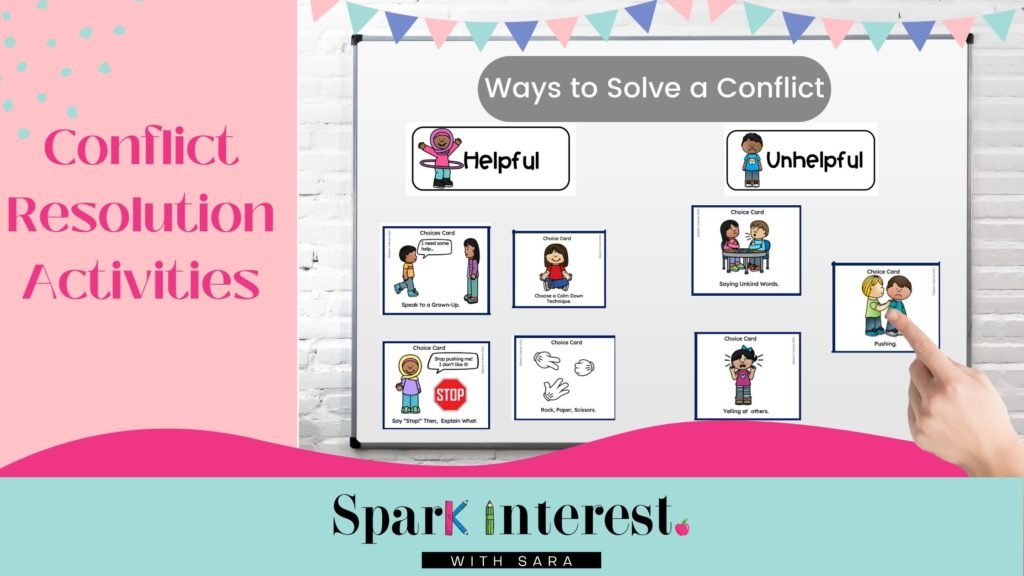
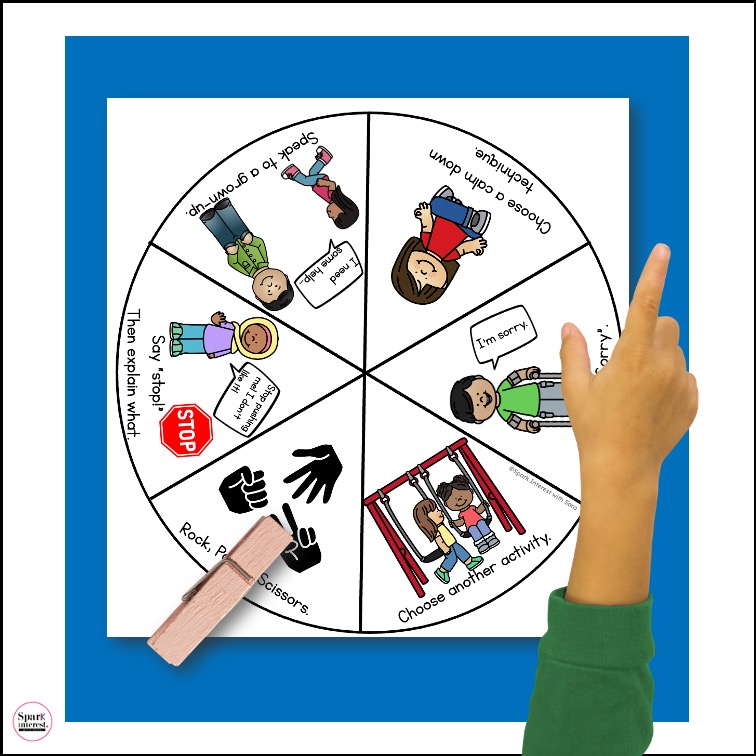
Start by creating a class list of simple techniques to resolve minor conflicts. This provides your preschoolers with go-to strategies they can remember and use independently. Here are six easy examples:
- Play rock, paper, scissors.
- Say “Stop!” and explain the problem.
- Choose a calm-down technique (e.g., deep breaths).
- Apologize and say, “I’m sorry.”
- Ask a grown-up for help.
- Choose another activity.
Display these strategies prominently in your classroom and refer to them regularly. Reinforce their use through fun and engaging practice activities.
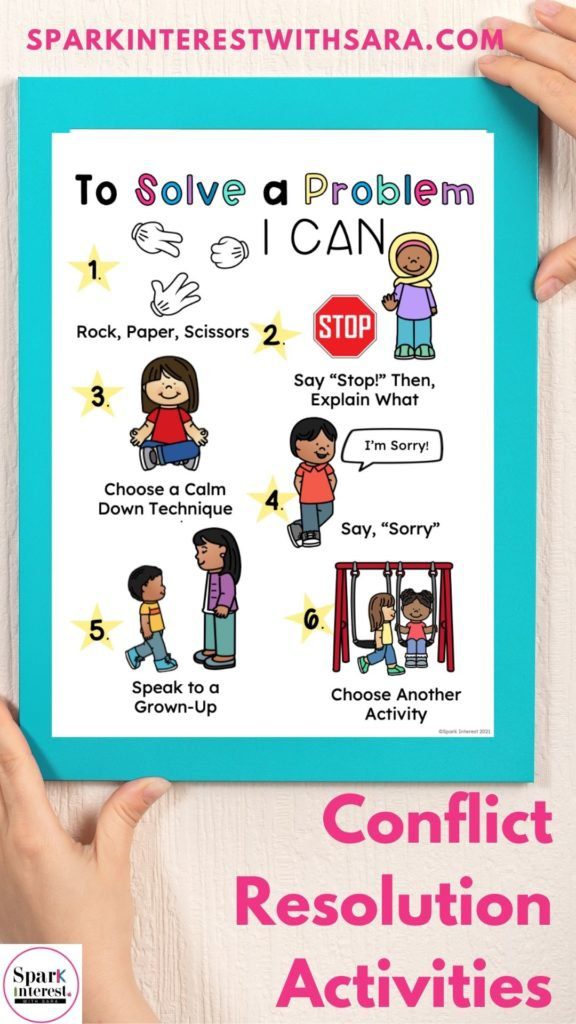
Once you have introduced each strategy, have them displayed in your room so your students can refer to it when needed. Practice these skills using the ideas below.
2. Use Games to Teach Conflict Resolution
The first thing you can do is to use games to teach conflict resolution in preschool. All children love games and will be more likely to remember something if we play an engaging game with the lesson. Also, playing games to reinforce concepts takes away the monotony of repetition.
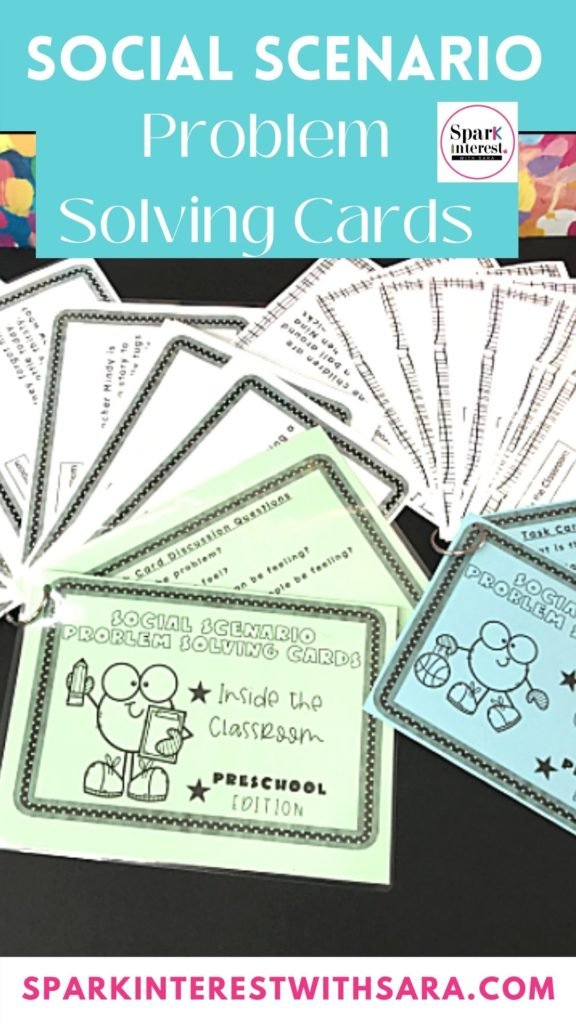
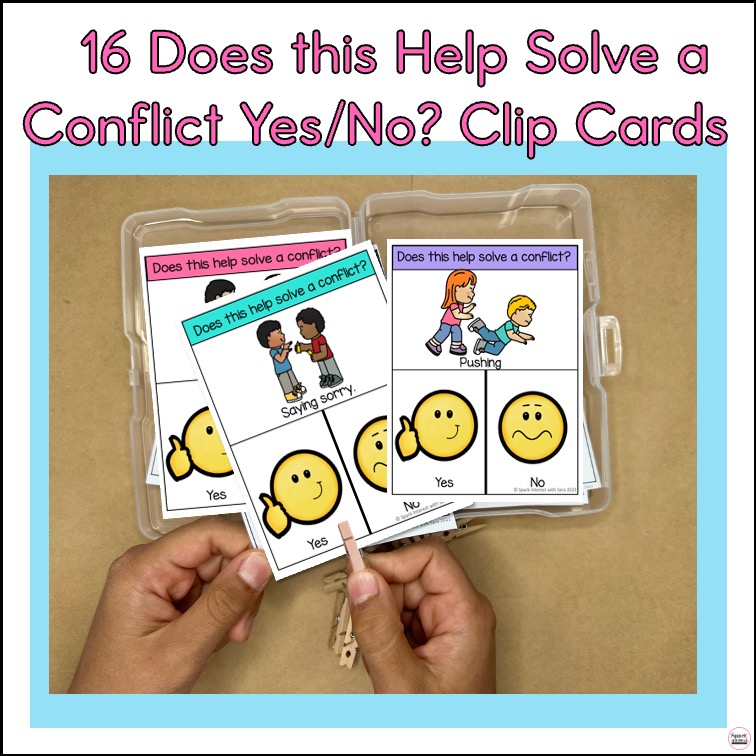
Using common social scenarios you could play What Could They Do? Once you have introduced your students to the ways to solve a conflict, place a grid in the middle of your group time area. Read the scenario & the children move to the strategy they think would work best. You could even take it a step further and ask them why they think that would work best.
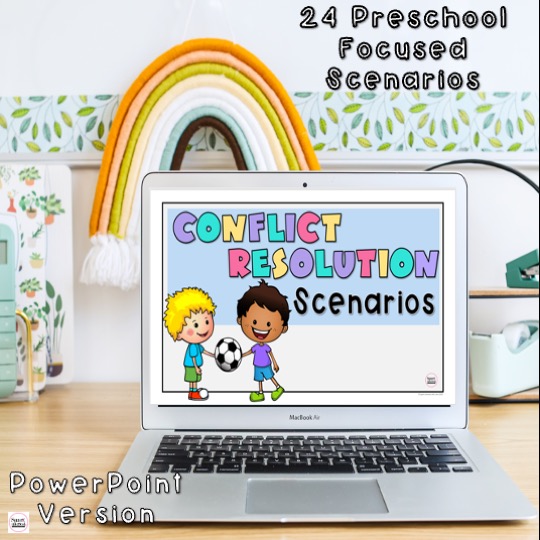
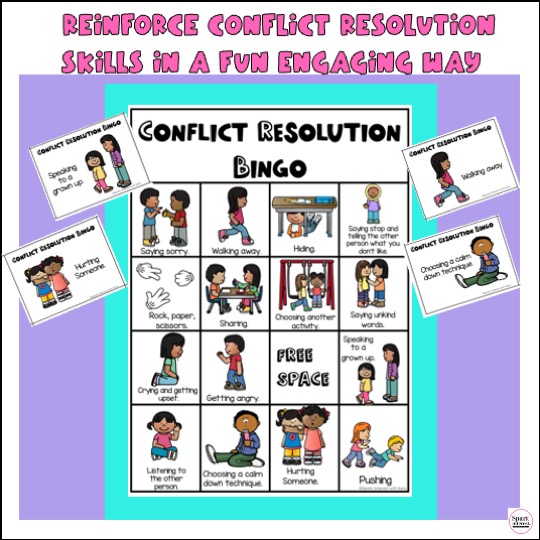
Bingo is also another great way to reinforce the different conflict resolution strategies in a fun and engaging way. Place all the different strategies on a bingo card, read a scenario and the children mark off a strategy they would use to solve the conflict.
Create puppets for your students to role-play different conflicts. Puppets will allow the children to explore these concepts in a different way. They may be more comfortable sharing their thoughts and ideas using the puppets.
3.Read Books about Conflict Resolution
Another excellent tool for teaching conflict resolution in preschool is the use of books. Our young learners are captivated by books, and I use this to my advantage! Picture books will encourage discussions around looking at different points of view, identifying the problem, and discussing possible solutions to solve the problem.
Some of my favorites are:
- Let’s Be Enemies – This book about conflict resolution is written by Janice May Udry. You students will love listening to the story of two friends who become enemies due to unresolved conflict.
- Our Class is a Family – Such a gorgeous book for building classroom community. Written by Shannon Olsen, children learn that their classroom is a place where it’s safe to be themselves, it’s okay to make mistakes, and it’s important to be a friend to others.
- Talk and Work It Out – This book focuses on how to peacefully solve problems using our words. Written by Cheri J. Meiners, It is a great book for teaching conflict resolution.
- Enemy Pie – Written by Derek Munson, this book helps children understand more about resolving conflicts and making friends.
4. Role-Play Conflict Scenarios
I love to use role-playing in the classroom, and The Early Start Group has some great information about the effectiveness of role-playing in an early childhood setting.
Giving students examples of different common conflicts is a crucial aspect of teaching conflict resolution in preschool. I introduce the scenario, then together we decide the best course of action. We even role-play the scenarios so students can see what this resolution technique would look like in action!
Young children love acting and role-playing which provides them with a safe place to explore these conflict resolution techniques. Students may feel more comfortable seeking advice and voicing their concerns when they are role-playing.
If you’d like to help your students role-play solving common classroom conflicts in a calm and supported way, this list of 40 conflict resolution scenarios for preschoolers might be a helpful next step.
5. Model Conflict Resolution Techniques
Finally, when teaching conflict resolution to preschoolers modeling and making it clear how you use conflict resolution techniques in your own life. This will demonstrate to your students how you deal with difficult situations.
Another way to model conflict resolution is to bring it to group time. For example, if the students are having conflicts around turn-taking with the new trucks, I gather the children, and we try to solve the problem together. Discuss the issue and elicit ways we can resolve this conflict. This allows the whole class to see different ideas and ways of thinking.
Involve Families in the Process
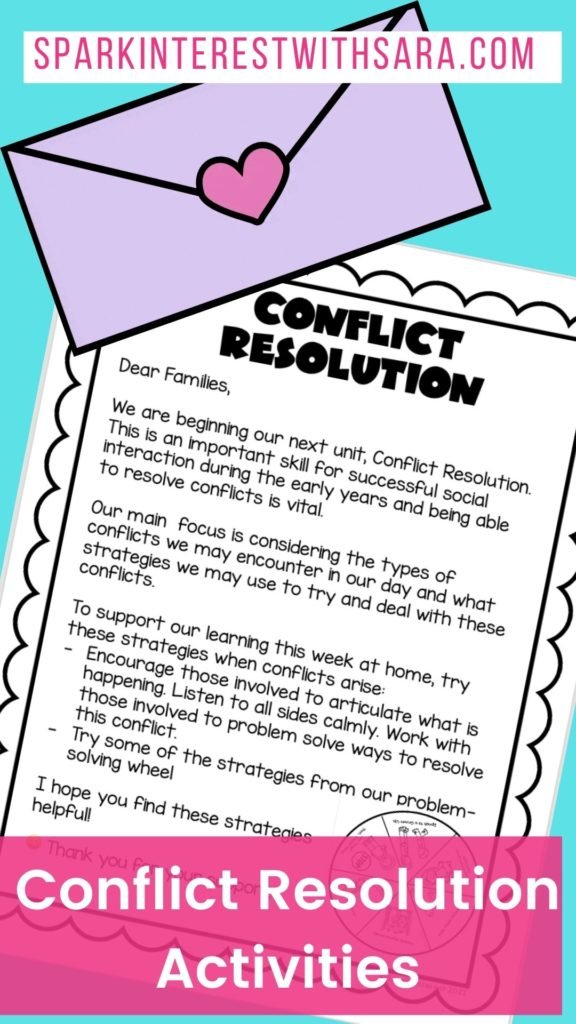
One last thing, don’t forget to involve families in what you are doing. Parents will love to hear what is working in the classroom and will appreciate knowing what strategies their children are learning. This allows families to learn the techniques and can implement them at home.
I hope these 5 preschool conflict resolution activities have given you some simple, practical ways to help your young learners begin working through conflicts more independently.
Like any social-emotional skill, conflict resolution takes time, practice, and lots of support. But with repeated opportunities to talk things through, role-play, play games, and explore solutions together, children can begin building skills they’ll use well beyond the preschool years.
Which activity do you think your class would enjoy most?
If you’d like more support with this topic, you might also enjoy these blog posts:
How to Help Preschoolers with Self Regulation
How to Teach Preschoolers Conflict Resolution Skills in Fun and Effective Ways
40 Conflict Resolution Scenarios for Preschoolers
And don’t forget to grab my FREE Conflict Resolution Booklet to add to your conflict resolution resources. Click on the image below to download your freebie.