
Some skills seem simple on the surface, but when you really stop and think about them, they are anything but simple for young learners.
Asking for help is one of those skills.
I think sometimes, as adults, we assume children will just do it naturally. If they need help, they’ll ask, right?
But in real classrooms, we know that is not always what happens.
Instead, a child might crumple their paper. Or burst into tears. Or wander off. Or sit there quietly, stuck, hoping you’ll notice. Sometimes they get frustrated and lash out. Sometimes they say, “I can’t do it,” when what they really mean is, “I need help and I don’t know how to ask.”
I’ve seen this so many times, especially with young children who are still learning how to make sense of big feelings, classroom expectations, and social situations all at once.
That’s why teaching children how to ask for help matters so much.
It is not just about getting through one tricky moment. It is about building confidence, communication skills, emotional awareness, and independence over time.
If you have been wondering how to teach preschoolers to ask for help, you are definitely not alone. This is a skill many young learners need us to teach slowly, clearly, and often.

Free classroom support:
If your students tend to get overwhelmed before they can ask for help, grab my Size of Reaction freebie. It is a simple and helpful way to build emotional awareness and support calmer responses in tricky moments.
Why asking for help is an important SEL skill for preschoolers
Asking for help is a social-emotional skill, but it is also so much more than that.
For a child to ask for help, they first have to realise something feels hard or confusing. Then they need to recognise that they cannot solve it on their own right now. Then they have to work out who they can go to, and find the words or confidence to actually ask.
That is a lot for a four-year-old.
When you break it down, it makes complete sense why so many children need this skill taught explicitly.
I think this is one of those areas where we can misread what is happening. A child who shuts down, avoids, or gets upset can sometimes look like they are refusing, when really they are missing the skill.
That shift matters.
Because once we start seeing asking for help as a skill to teach, not just a behaviour to react to, everything changes.
This is also one of the reasons it fits so beautifully into social emotional learning for preschool and kindergarten. It supports self-awareness, communication, confidence, and relationship skills all at once.
What asking for help can look like in the classroom
You have probably seen this too.
A child cannot get their lunchbox open, but instead of asking, they get teary.
A preschooler is confused by the activity, but rather than putting up their hand, they sit there frozen.
Someone cannot find where to put their work, so they just stand there, hovering.
Another child gets stuck with a zipper, a glue lid, or a pencil sharpener, and suddenly it turns into a much bigger emotional moment than you expected.
These everyday classroom moments are exactly where this skill lives.
And honestly, I think that is why this topic matters so much.
Asking for help for preschoolers is not some big abstract life lesson. It shows up in the tiny, ordinary moments of a school day.
That’s where our young learners need support.
Why some preschoolers struggle to ask for help
There are so many reasons a child might find it hard to ask for help.
- Sometimes they do not realise they need help until they are already overwhelmed.
- Sometimes they are shy.
- Sometimes they are worried they will get in trouble.
- Sometimes they do not know who they can ask.
- Sometimes they simply do not have the words yet.
- And sometimes, if we are being honest, they are so used to adults jumping in quickly that they have not had many chances to practise asking at all.
I have also noticed that some children really want to be independent. They want to do it themselves, which is beautiful, but it can also make help-seeking feel hard. They can see asking for help as failing, rather than as a normal and healthy thing to do.
That is why I like to teach asking for help in a really calm, matter-of-fact way. Not as something children only do when everything is going wrong, but as a normal part of learning and being in a classroom community.
How to teach preschoolers to ask for help
The good news is that asking for help can absolutely be taught.
And like so many preschool social skills, it works best when we keep it simple, visual, and woven into everyday classroom life.
Here are some of the ways I like to teach it.
1. Start with the feeling of being stuck
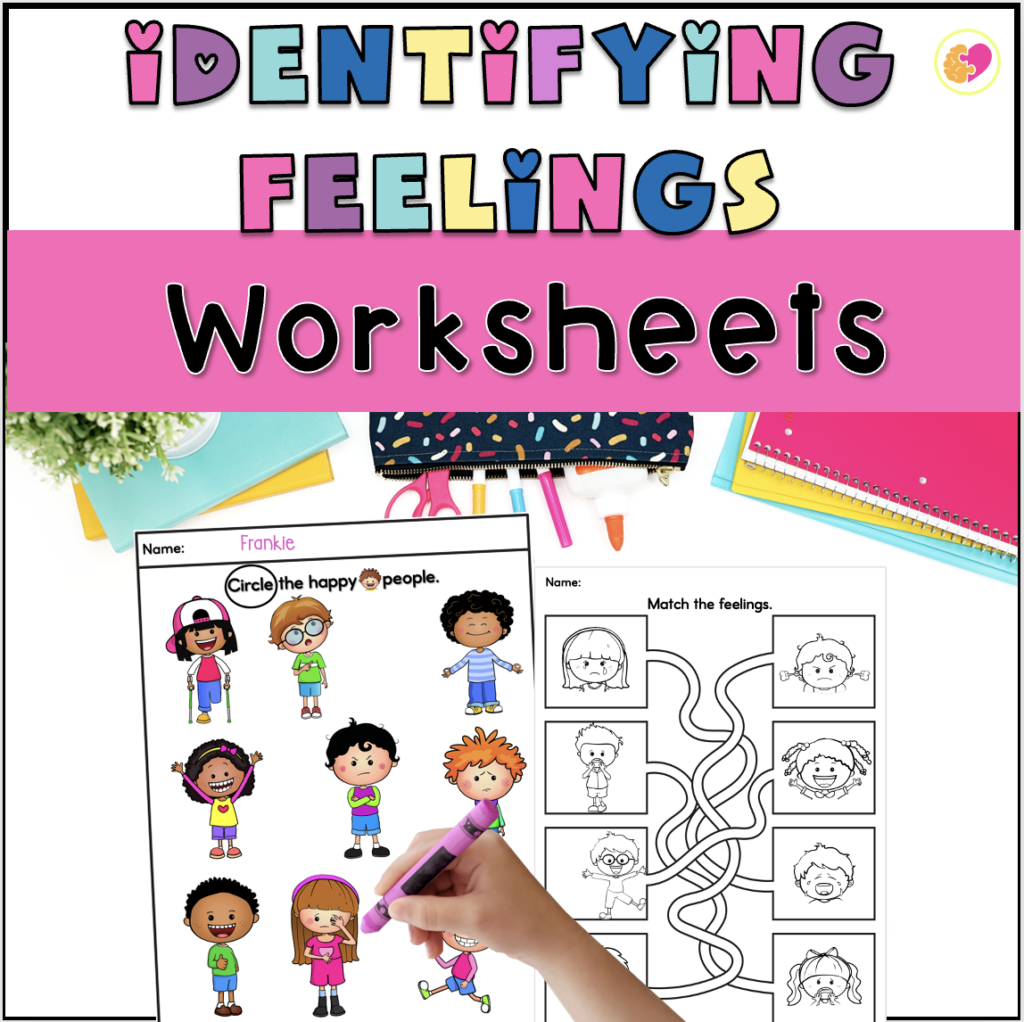
Before children can ask for help, they need to recognise that feeling of being stuck.
That might sound obvious, but it really is the first step.
I like to talk with children about what it feels like when something is hard. We might say things like:
- “Sometimes our brain feels confused.”
- “Sometimes we feel frustrated.”
- “Sometimes we do not know what to do next.”
- “Sometimes we feel stuck and need help.”
This gives children language for the experience before we ever get to the asking part.
It also connects beautifully with feelings and emotions work, because emotional awareness is such a big part of help-seeking.
2. Be really clear about who they can ask
Young children do not always automatically know who is available to help them.
Yes, it might seem obvious to us, but not always to them.
So I like to be explicit. We talk about trusted helpers at school and at home. We name them. We give examples.
That might include:
- the teacher
- an educator or aide
- a friend
- a sibling
- a family member
This can be especially helpful for children who freeze in the moment. If they already have a mental list of safe people, it is one less thing for them to work out when they are feeling flustered.
3. Teach the actual words children can use
This is a big one.
A lot of children know they need help, but they do not know what to say. Or they only have one phrase, like “I can’t do it,” which can come out sounding bigger than what they really mean.
So I like to model and practise simple, useful phrases such as:
- “Can you help me, please?”
- “I’m not sure what to do.”
- “Can you show me?”
- “I need help with this.”
- “I feel stuck.”
Simple language. Repeated often.
That repetition really matters.
Because when children are frustrated, they are not going to come up with perfect language on the spot. They need words that feel familiar and easy to reach for.
4. Break asking for help into clear steps
One of the most helpful things we can do for young learners is take a social skill and make it visible.
Instead of leaving it vague, we can break it down into a few clear steps.
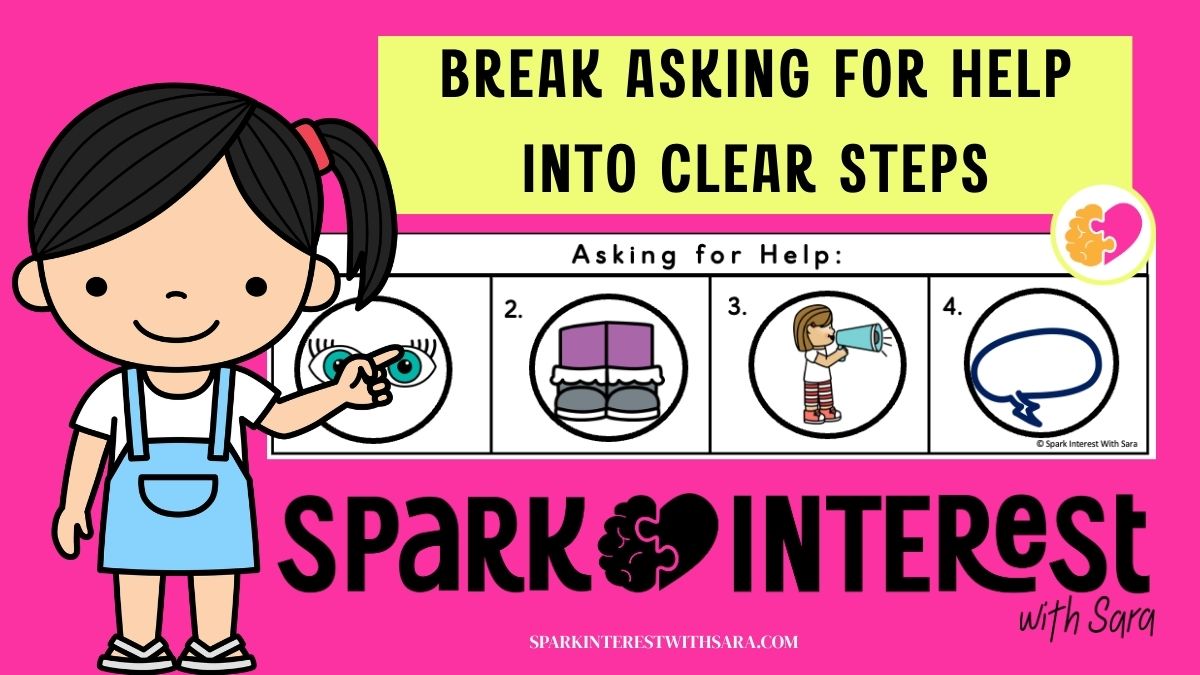
For example:
- Look for a person who may be able to help
- Go to that person
- In a loud clear voice tell them you need help
- Explain what you need help with
Once children can see the process, it feels much more manageable.
I find visuals make a big difference here, especially for little learners who need that extra support to remember what to do in the moment.
5. Use asking for help activities, role play, and real-life scenarios
This is where the learning really starts to stick.
Children need opportunities to practise when they are calm, not just in the middle of real frustration.
I love using simple asking for help activities and social scenarios for this. Things like:
- You cannot open your lunchbox.
- You do not know where to sit.
- You are confused about the activity.
- Your shoelace is undone.
- Someone took the toy you were using.
- You cannot zip your bag.
Then we talk through it together.
Is this a time to ask for help?
Who could you ask?
What could you say?
These little discussions and role plays are so powerful because they help children rehearse the skill before they actually need it.
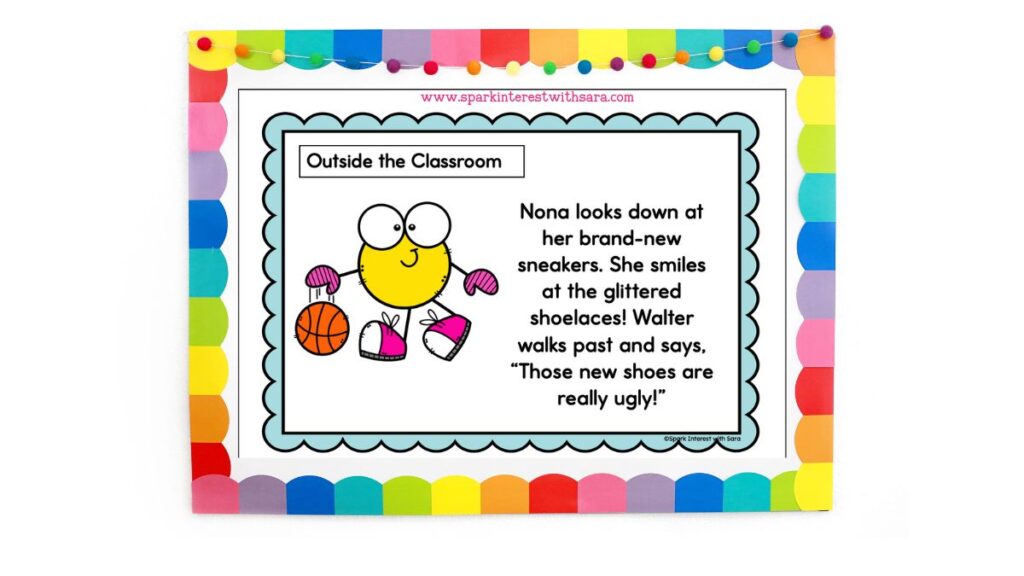
It can also help children to know whether they are dealing with a small, medium, or big problem. This 50 Size of the Problem examples blog post gives you lots of simple scenarios to talk through together.
6. Model asking for help yourself
Honestly, I think this is one of the easiest and most powerful things we can do.
Let children hear you ask for help.
You might say:
- “I’m not sure where I put that. I’m going to ask for help.”
- “Can you help me carry this?”
- “This is tricky. I might need some help.”
When we model help-seeking in a calm and everyday way, we show children that asking for help is normal. It is not embarrassing. It is not a sign that you have failed. It is just something people do when they need support.
And that is such an important message.
7. Notice and name it when children do it
When a child asks for help, I always think it is worth slowing down and noticing.
Not in a huge over-the-top way. Just warmly and specifically.
You might say:
- “You knew you were stuck and you asked for help. That was a great choice.”
- “I’m glad you used your words.”
- “You asked so clearly. That helped me know what you needed.”
That kind of feedback reinforces the skill itself, not just the outcome.
Simple asking for help activities for Preschool, Pre-K, and Kindergarten
If you want to be more intentional with this skill, here are a few easy asking for help activities for preschoolers you can use in the classroom.
📚 Use books as conversation starters
Books are such a lovely way into social-emotional learning.
As you read, pause and ask questions like:
- How is the character feeling?
- What problem are they having?
- Could they ask someone for help?
- What might they say?
It keeps the conversation grounded in something concrete and gives children another way to explore the idea.
⚓️ Make an anchor chart together
I love a good anchor chart for this topic.
You could make one together with headings like:
- When I need help, I can…
- People who can help me are…
- I can say…
Then keep it up where children can actually use it.
Not just as cute decor, but as a real classroom tool.
🎙️ Practise with partner talk
Give children a simple scenario and let them practise what they might say.
This can be quick, low-pressure, and surprisingly effective.
Young children often need that chance to try the words out loud before they can use them independently in real life.
👀 Use visual reminders
Posters, sequencing strips, and simple prompts can really support children in the moment.
Because let’s be honest, when a child is frustrated, memory is not always their strongest tool. Having a visual reminder right there can make all the difference.
∞ Revisit the skill often
This is not a one-time lesson.
I wish it worked that way, but like most social skills, it needs revisiting again and again.
A quick reminder during morning meeting. A role play in small group. A quiet prompt during a tricky classroom moment. It all adds up.
An asking for help lesson for Preschool, Pre-K, and Kindergarten
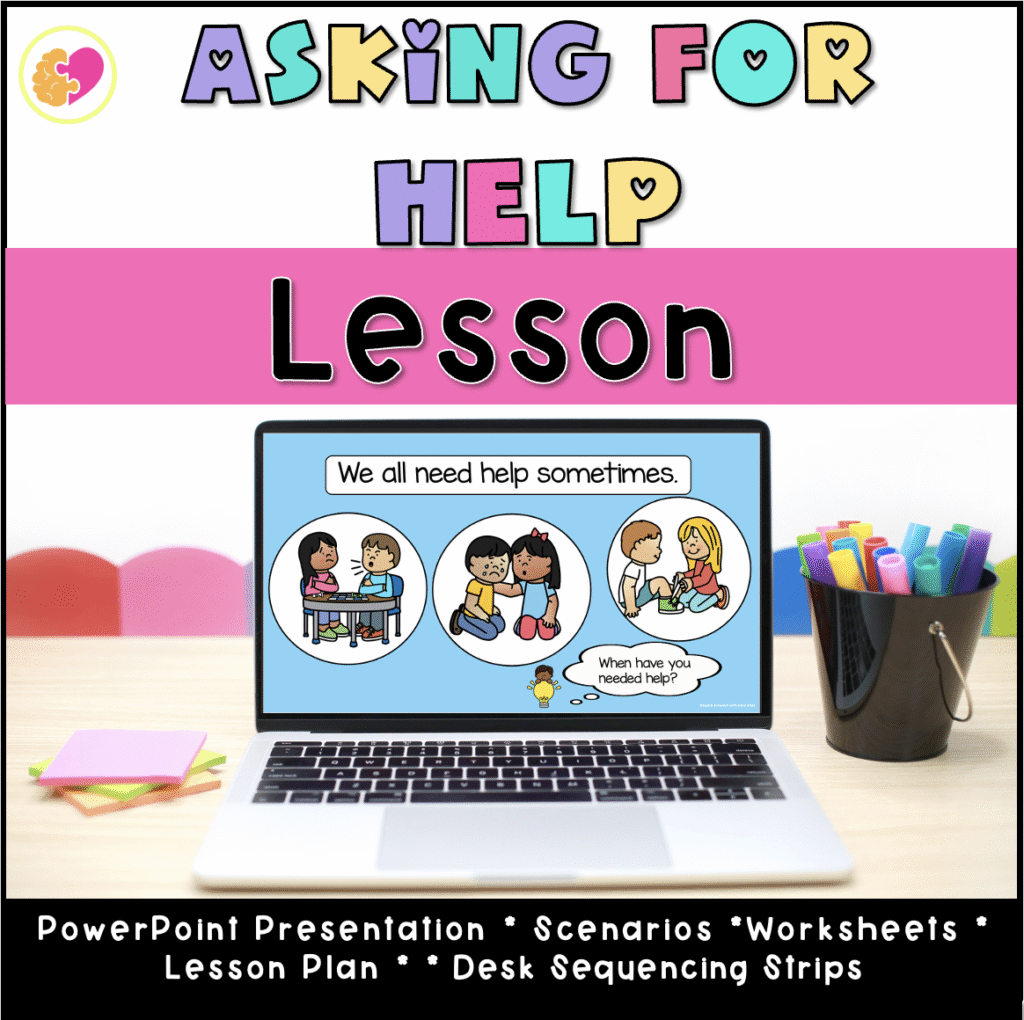
If you want a ready-to-use way to teach this skill, I created an Asking for Help Lesson for Preschool, Pre-K, and Kindergarten that walks children through the whole process in a simple, developmentally appropriate way.
It includes:
- a detailed lesson plan
- PowerPoint slides
- asking for help scenarios
- a visual poster with the 4 steps for asking for help
- printables
- sequencing strips for extra support
It is designed for real classrooms and works well for SEL lessons, morning meeting, school counselling, small groups, and classroom guidance.
Other SEL resources to pair with asking for help
Asking for help does not sit on its own.
It connects so naturally with other social-emotional skills we teach all the time, like:
That is one of the reasons I love teaching it. It fits into the bigger picture of helping children communicate, regulate, and navigate the classroom with more confidence.

Final thoughts on teaching preschoolers to ask for help
Teaching children to ask for help is one of those things that can make such a difference, not just academically, but emotionally too.
When children know how to ask for support, they are more likely to stay engaged, feel safe, and keep trying.
And for us as teachers, it means we are not always trying to decode the behaviour on the surface. We can get underneath it and teach the skill that is missing.
That feels like a much more compassionate place to work from.
And honestly, I think that is what so much good SEL teaching is. Seeing the skill beneath the struggle and giving children the support they need to grow it.
Frequently Asked Questions About Teaching Asking for Help
How do you teach preschoolers to ask for help?
Teach children to notice when they feel stuck, identify trusted helpers, and practise simple phrases they can use to ask for support.
Why is asking for help an important social skill?
Asking for help builds confidence, communication, emotional awareness, and problem-solving skills.
What are some asking for help activities for preschoolers?
Role play, social scenarios, anchor charts, visual reminders, and picture books are all great ways to teach this skill.

